

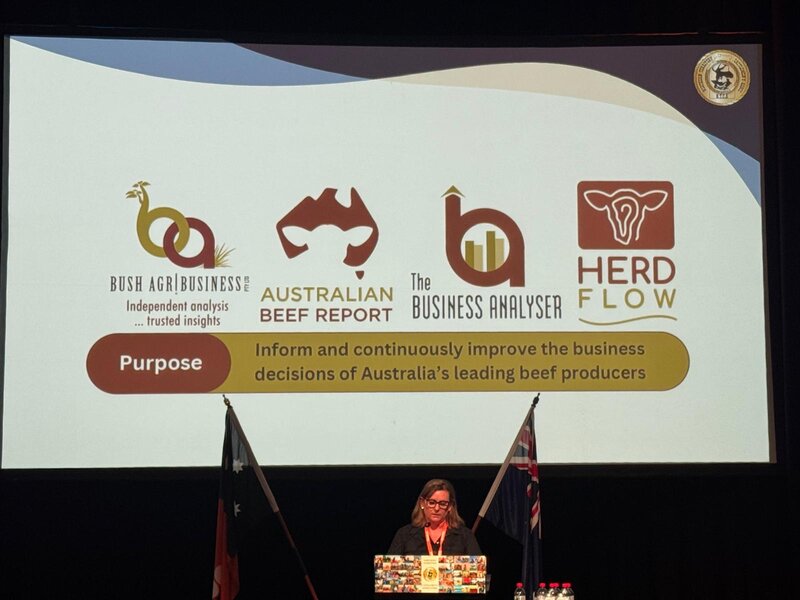
Simone delivered a presentation at the 2026 NTCA Conference in Darwin, focused on what it takes to be a thriving northern beef business. Here is a short wrap up of the key themes and takeaways to consider in your own business.
Northern beef businesses and life are intertwined
There are few situations where business, family, work, and community intersect as completely as they do in a northern beef business. Home, work, and family aren't separate; they are inextricably linked in both family and corporate environments.
This overlap is what makes the industry so unique and rewarding, but it’s also what makes it incredibly challenging. It stands to reason that if you can achieve a better beef business, you will also improve the aspects of your life that overlap with it like better relationships, peace of mind, more clarity, a sense of control, and peace of mind. By building a better business, you are ultimately building your best life.
Juggling all the balls in the air
Often, it can feel like you are trying to juggle a lot and keep all the balls in the air. Northern beef businesses can be complex systems involving capital, risk, land management, production, and people. We get so busy juggling the balls or hoping today isn’t the day one of them falls, that we don’t have the time or perspective to stop and check if there is a better way.
At Bush AgriBusiness, we have the privilege of working with some high performing beef businesses and have observed the things they do differently. They understand that success isn't an accident; it is by design. We’ve summarised these into three main focus areas and some practical applications: Strategy, Culture, and Performance.
The 3 Pillars of a Better Beef Business
1. Strategy (The Path)
Strategy is your path. It is about defining where you are headed in the long term and a series of decisions about choosing the game you are playing and how you plan to win it.
- Strategy is not a long-winded document; it is a clear set of decisions that informs the plans you put in place.
- It requires asking fundamental questions: Why are we doing this? What do we want to achieve? What can we be the best at?
- Strategy needs to be brought out of your head and put down on paper. Consider documenting the high level strategy on one clear page including Vision (the point your are aiming for), Values (what keeps you on track), Purpose (why you are in business) and Goals (what needs to be done).
- Once your strategy is right, keep it front of mind so it becomes the ultimate filter for every future business decision and makes it easier for everyone to get on board.
2. Culture (The Engine)
Culture is the beating heart of your business. It is simply how you work together and what makes the business tick.
- It might sound like an abstract concept, but strong cultures need to be lived, breathed and practically implemented every day
- Positive culture shows up as things like trust, respect, and mutual understanding.
- If you don’t intentionally create, model, and monitor your culture, you may inadvertently find that an accidental one has been created for you.
- You will know your culture is working if people are living it, even when you are not around to make sure they are.
- Practically, this means defining clear roles, responsibilities and lines of communication. It is also important to understand your own personality and communication styles and those of others.
3. Performance (The Proof)
Performance is your proof. It shows you exactly where your strengths lie, where you need to improve, and whether your strategy is actually working or needs recalibration.
- Tracking performance requires regular check-ins, measuring what matters, and eliminating distractions.
- Our long term data reveals that top performing beef businesses generate more income per animal, have targeted herd expenditure, better labour efficiency, and maintain a lower cost of production. They are also remarkably consistent at doing so.
- Clear performance proof requires regular check ins, monitoring, measuring and making adjustments. This is the basis for informed discussion and decision making to achieve the strategy.
It is important to maintain focus and attention on all three of these elements over time. For example, you cannot outperform an unclear strategy or a negative culture. If one of the legs is weak, the stool will fall over when put under pressure.
Perspectives on Succession
Succession is a big and often fraught topic in agriculture, but it shouldn’t be viewed as an isolated, standalone event.
Instead, succession is a continuous management transition plan. Management succession also doesn’t only apply to family businesses; in fact, it happens more often in company settings.
To be successful, it must align with your overall strategy, be built on your everyday culture, and be informed by your actual business performance. When you have a clear strategy, open communication, and a focus on developing people to step into roles they aren't quite ready for yet, the transfer of management becomes more achievable.
Your challenge from here
These three focus areas are designed to cut through the overwhelm and let you in on what we see the top performers doing to be constantly better in business.
This takes time and intention. Don’t let the fact that it may take time and you can’t achieve it all at once stop you from getting started. Pick one or two things, start there and be consistent. It may not be perfect, but it will be momentum in the right direction.
The top performers design their business around strategy, culture and performance. While it may not be easy, it is worth it. Improving in these three areas will benefit not just your business but the other aspects of your life that are so intrinsically linked to it. There are practical steps you can take to create a better beef business, no matter how small you start.

