

If you were to ask a group of producers what their reproductive rate is and how they calculate it, you’d get as many different methods of calculating as you do results. In our experience, the quoted figures are often an overestimate compared to when the actual rate is calculated over time from herd data. Is the 80% rate boasted at the pub a true reflection of reproductive success?
Of all the measures we report on beef business performance, reproductive rate is the most difficult to measure. It is also the number one income driver for a breeding herd, so it is critical to get it right. This is why we at Bush AgriBusiness have been focusing on this a lot lately and been discussing it at length with clients. From this, we have developed a standardised and accurate approach for the industry to calculate reproductive rate.
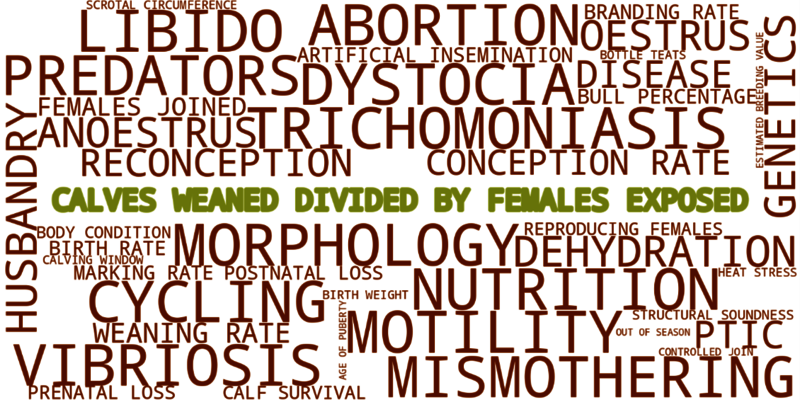
The below diagram shows the stages and points of leakage during the reproductive cycle. There are many different calculations that calculate performance for different points along the reproductive cycle. Although we suggest only one calculation really tells us overall reproductive success, in its simplest form, calves weaned as a percentage of females exposed to bulls.
Reproductive Success -A live weaner from a breeding age reproducing female every 12 months (i.e. a 12mth inter-calving interval).

An essential starting point in calculating any measure of herd performance is having accurate and herd data. This is why we developed the Australian Herd Classification Guidelines to maintain a reconciled herd inventory. By clearly defining herd numbers throughout time using the primary attributes in the guidelines, this allows reproductive rate to be calculated by using the total number of calves weaned divided by the breeding age females on hand at time of conception (we use 10 months prior to the cohort’s median birth month (MBM)). By using the total number of weaners of an age group (i.e. all #26’s), this measure of reproductive success incorporates all the contributing factors displayed in Figure 1 & 2 into a single number.
We think it is important to link the calculation to herd inventory, as this provides validation of the results and maintains consistency overtime. There also needs to be an adjustment made for breeding age females that move in and out of the inventory after the assumed conception date, as well as for young females given the chance to conceive at a different age to your targeted first joining age. This allows the calculation to accurately reflect the number of females used to produce the cohort of weaners. Females that are sold for reasons such as old age or previous calf pregnancy performance are excluded from the calculation while sales of empty females for the current join remain included as non-performers. All breeding age reproducing females purchased during the period are included by default, although for those that were intended for the subsequent calf can be excluded.

Where:
Total Calves Weaned | The total number of calves weaned in a given age group (e.g. all #26 or orange tags). |
Breeding Females | All females of breeding age (dependent on whether production system has first joining as yearling or 2yo) classified as reproducing females. |
MBM | Median Birth Month for AgeYear #XX drop of calves. |
Ad | Net Adjustment: This accounts for movements in and out of the Breeding age reproducing female category (during the 12-month period from 10 months prior to median birth month). -Old cows culled for age after prior calf weaned irrespective of pregnancy status of current calf are excluded, -Any females culled for failing to produce prior year weaner are excluded. -Any surplus females sold that were pregnant within the desired window are excluded, -Any females purchased in to be joined for the next age group of calves, not the one being analysed, are excluded. -If first joining is as yearlings, any yearlings not joined as yearlings are excluded. Similarly, if first joining is at 2yo, any that were joined as yearlings are included
|
We believe that by having and applying a consistent approach used to calculate such a critical performance metric, producers can track progress and compare against industry benchmarks with confidence. Consistency and transparency of calculated herd performance measures will benefit both individual businesses and the industry as a whole. We therefore propose this approach as the industry standard.
The calculation has been included into the HerdFlow platform, which records and reports high level herd inventory data to allow performance measures like this to be calculated. New users are invited to activate a free trial using their myMLA account (See FAQ's for how to use the calculation).

